The independence of the Zimbabwe Electoral Commission (ZEC)

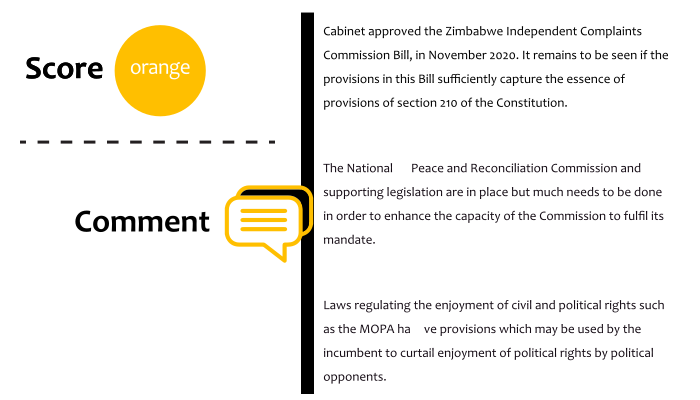
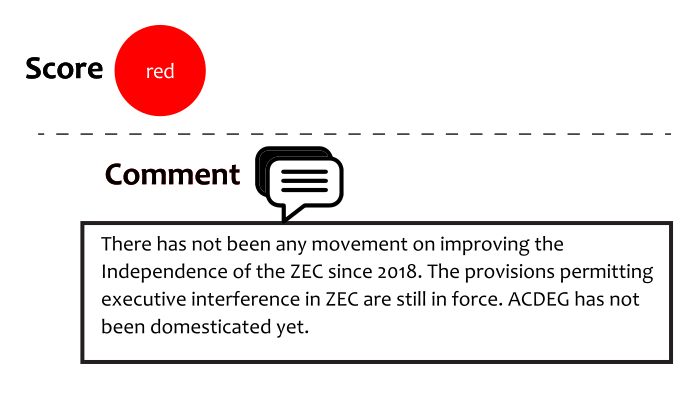
  • The independence of the Zimbabwe Electoral Commission (ZEC) is provided for under Section 235 of the Constitution. Provisions of the Electoral Law that offend this principle must be reviewed. These include sections 192(6) and (12) of the Electoral Act, which permit Executive interference with the ZEC.
  • Pursuant to its signature of the African Charter on Democracy, Elections and Governance (ACDEG) in February 2018, Zimbabwe should proceed to give life to the Charter through its domestication and implementation.
  •  
    Assessment:

  • The Electoral Act does not empower ZEC to make and approve electoral regulations. ZEC still needs get approval from the Minister of Justice, Legal and Parliamentary Affairs for the Commission to introduce regulations for use by the institution’s staff.
  • In October 2020, the overturning by the Government of a decision by ZEC to lift the suspension of by-elections demonstrated that the institution could not make decisions independent of approval by the Government and the Ministry of Justice Legal and Parliamentary Affairs (ZEC’s parent Ministry).
  • Zimbabwe is one of the 25 African states that are yet to ratify the ACDEG. Signing is not enough when consent to be bound is to be expressed by ratification. Ratification of ACDEG will demonstrate that Zimbabwe is committed and serious about the promotion of democratic principles and institutions, popular participation, human rights, the rule of law, good governance, condemnation and unconstitutional changes of governments, sustainable development, peace and security as enshrined in the AU Constitutive Act and ACDEG[1].
  • According to the Inter-Ministerial Taskforce on the Alignment of Legislation to the Constitution (IMT) the alignment of Electoral Act [Chapter 2:13] to the Constitution is complete. ZESN is of contrary view and has made submissions to both government and Parliament bringing to their attentions areas where the current Electoral Act is not in sync with the Constitution.
  • Download Full Report

    [1] http://aga-platform.org/sites/default/files/2017-08/Africa%27s%20Governance%20Dividends%20%26%20Deficits%20-%20Newsletter%20%28Jan-June%202017%29.pdf

    ZESN WELCOMES RESUMPTION OF VOTER REGISTRATION

    25 March 2021 – The Zimbabwe Election Support Network (ZESN) commends ZEC for adhering to the dictates of the law as espoused in the Electoral Act on the need for continuous voter registration. ZEC announced the resumption of electoral activities through a Press Statement, published in the mainstream media and its social media platforms on Tuesday 23 March 2021.

    The Network is however irked by the continued suspension of by-elections without consulting stakeholders. ZESN calls on the ZEC to publicize and implement its COVID-19 Policy on Electoral Activities and outline how the Policy will be used to administer by-elections under COVID-19. Accordingly, selective application of the law by allowing for “some” electoral processes to be conducted at the peril of others is  unendurable given the fact that the continuous suspension of by-elections closes up what is left of the shrinking democratic space and undermines the civil and political entitlements of citizens.

    ZESN notes that the umbrella ban on electoral activities issued on 2 January 2021 through the promulgation of Statutory Instrument 10 0f 2021 by the Minister of Health and Child Care which moved Zimbabwe to level 4 from level 2 of the National COVID-19 lockdown affected the voter registration exercise which had resumed during the last quarter of 2020. Voter registration, being a key component of the electoral cycle, has to be conducted on a continuous basis to keep the voter’s roll up to date.

    The Network will continue to advocate for the institution of electoral reforms that are key in ensuring the holding of credible and fair electoral processes. Some of these reforms include; strengthening of the ZEC Independence and building trust and confidence; provision of continuous and more robust and inclusive voter education; transparency in key electoral processes delimitation; and representation of Special Groups (women, youth, and people with disabilities) among others.

    More so, ZESN will continue to enhance the capacity of youths, women and People with Disabilities to advocate for electoral reforms by 2023 by facilitating sustained engagement between the ZEC and key electoral stakeholders such as political parties, Civil Society Organisations and relevant institutions supporting democracy throughout the electoral cycle. Further, in view of the COVID-19 context; ZESN will prioritize provision of Civic and Voter Education through media campaigns virtually and using radio since physical campaigns cannot be held at the moment mobilizing eligible voters, women, youth, and people with disabilities as well as marginalized groups to register to vote and if need be to transfer their registration. The move is meant to ensure enhanced and informed citizens’ participation in the voter registration exercise.

    The government of Zimbabwe must not negate its obligation to adequately fund the Electoral Commission and to institute the necessary reforms to meet the constitutional benchmarks and regionally and internationally agreed standards.///ENDS

    PROMOTING DEMOCRATIC ELECTIONS IN ZIMBABWE

    ZESN Chairperson: +263772234891

    ZESN Acting Director: +26377219462

    +263 (242) 791443, 798193, 791803, 250736

    zesn2011@zesn.net, info@zesn.net

    Facebook: ZESN1

    Twitter:@ZESN1

    Website: www.zesn.org.zw

    ZESN STATEMENT ON INTERNATIONAL WOMEN’S DAY COMMEMORATIONS

    8 March 2021 – As we commemorate International Women’s Day running under the theme, “Women in leadership: Achieving an equal future in a COVID-19 world.” ZESN calls on all electoral stakeholders, the government and traditional leadership to end the exclusion and marginalization of women and girls in governance processes in Zimbabwe. International Women’s Day comes at a time when the country is making strides to contain the COVID-19 pandemic and women are bearing the brunt as they are at risk of transmission from care giving with some not even being able to take care of themselves when sick leading to  fatalities.

    ZESN notes with concern that notwithstanding the legislative framework to ensure gender equality and equity as well as gender mainstreaming in electoral processes to enhance women’s participation in democratic governance processes, Zimbabwe has not yet achieved equal representation in public office including the Presidium and other decision making positions. Political parties are also genderblind in their composition as there are no measures in place to ensure they adhere to the Constitutional dictates for their appointments and candidate selection. Furthermore, there are barriers that women face such as physical, verbal, cyber, emotional and sexual abuse which discourage participation in democratic electoral and governance processes.

    The COVID-19 pandemic presents an opportunity for the government to take stock of the implementation of a plethora of domestic laws, regional and international conventions and protocols on according women equal opportunities in governance processes. Women’s Day comes at a time when ZESN and other CSOs are lobbying government and political parties to increase women’s representation in the government and participation as political candidates as a way of empowering women to achieve gender parity. This is important because when women do not express their voice or participate fully, their needs will remain unattended to and society as a whole falls short of realising its full potential.

    International Women’s Day is celebrated annually on 8 March and offers an opportunity to reflect on progress made with regards to gender equality, to call for change and to celebrate acts of courage and determination by ordinary women who have played an extraordinary role in the history and development of their countries and communities.

    The Zimbabwe Constitution under Section 17 calls on the State to promote full gender balance in Zimbabwean society, and in particular – with regard to promoting the full participation of women in all spheres of Zimbabwean society on the basis of equality with men and to take legislative and other measures to ensure that both genders are equally represented in all institutions and agencies of government at every level; and that women should constitute at least half of members of all Commissions and other elective and appointed governmental bodies established under the Constitution or any Act of Parliament.

    ZESN calls upon the government to sincerely promote gender balance and to take positive measures to rectify gender discrimination and imbalances that continue to exist. The Network acknowledges and applauds the work that is being done by women organisations and other CSOs in ensuring that women remain engaged in electoral, governance and democracy issues. Happy International Women’s Day to all women.//ENDS

    PROMOTING DEMOCRATIC ELECTIONS IN ZIMBABWE
    ZESN Chairperson : +263772234891
    ZESN National Director : +263712415902
    zesn2011@zesn.net, info@zesn.net
    Facebook: ZESN1
    Twitter:@ZESN1
    Website: www.zesn.org.zw

    ZESN STATEMENT ON INTERNATIONAL WOMEN’S DAY

    As we commemorate International Women’s Day running under the theme, “Women in leadership: Achieving an equal future in a COVID-19 world.” ZESN calls on all electoral stakeholders, the government and traditional leadership to end the exclusion and marginalization of women and girls in governance processes in Zimbabwe. International Women’s Day comes at a time when the country is making strides to contain the COVID-19 pandemic and women are bearing the brunt as they are at risk of transmission from care giving with some not even being able to take care of themselves when sick leading to fatalities.

    ZESN notes with concern that notwithstanding the legislative framework to ensure gender equality and equity as well as gender mainstreaming in electoral processes to enhance women’s participation in democratic governance processes, Zimbabwe has not yet achieved equal representation in public office including the Presidium and other decision making positions. Political parties are also genderblind in their composition as there are no measures in place to ensure they adhere to the Constitutional dictates for their appointments and candidate selection. Furthermore, there are barriers that women face such as physical, verbal, cyber, emotional and sexual abuse which discourage participation in democratic electoral and governance processes.

    The COVID-19 pandemic presents an opportunity for the government to take stock of the implementation of a plethora of domestic laws, regional and international conventions and protocols on according women equal opportunities in governance processes. Women’s Day comes at a time when ZESN and other CSOs are also lobbying government and political parties to increase women’s representation in the government and participation as political candidates as a way of empowering women to achieve gender parity. This is important because when women do not express their voice or participate fully, their needs will remain unattended to and society as a whole falls short of realising its full potential.

    Download full report

    ZESN STATEMENT ON NATIONAL BUDGET ON KEY ELECTORAL ACTIVITIES

    Press Statement

    ZESN STATEMENT ON NATIONAL BUDGET ON KEY ELECTORAL ACTIVITIES

    16 DECEMBER 2020 – The Zimbabwe Election Support Network is deeply concerned by the allocation of an inadequate budget to the Zimbabwe Electoral Commission which militates against the capacity of the Commission to administer free, fair, and credible elections thus undermining democracy. ZESN implores government to demonstrate political will by sufficiently supporting ZEC financially.

    The Parliamentary Portfolio Committee on Justice and Legal Affairs has revealed in a report on the 2021 National Budget that ZEC was allocated $2.3 billion instead of $12.4 billion that the Commission had indicated it would need for the year 2021.

    ZESN expresses dismay at ZEC’s paltry budgetary allocation which MPs said would not be adequate to enable the Commission to conduct the much awaited process of delimiting electoral boundaries ahead of the 2023 elections. Members of Parliament indicated that ZEC would need $8.6 billion for the delimitation process, yet only $1.744 billion was appropriated. In general, the delimitation of electoral boundaries is a challenging technical endeavour that is usually lengthy and costly.

    Delimitation is a key electoral process with implications for electoral outcomes, including the fairness and credibility of elections. A properly conducted delimitation exercise ensures equality of voting strength, fair and adequate representation of the electorate, contiguity and compactness in the geometric shape of constituencies and, importantly in the case of Zimbabwe, that the variance in the number of voters in all constituencies falls within the +/-20% constitutional threshold.

    ZESN is of the view that the move by government to leave a variance of 81% between ZEC’s proposed budget of 12.4 billion and the actual allocation of $2.3 billion further weakens democracy in the country given that, a few months ago, by-elections were indefinitely suspended on account of the COVID-19 pandemic despite the fact that in recent months many countries, including in Africa, have been holding elections under similar circumstances.

    Zimbabwe stands guided by the tenets of democracy which are based on, among others, respect for the Constitution, rule of law, fundamental human rights and freedoms, good governance and regular elections, all rooted in the watershed elections of 1980 which marked a transition to independence.

    There is therefore need for the government to uphold the tenets of the democracy through availing adequate resources to enable the holding of all key electoral processes in-between general elections and during general elections that should be held every five years as stipulated by the supreme law of the country.

    ZESN reiterates that there is need for government and all institutions supporting democracy to create a conducive environment that ensures that the basic pillars of democracy are upheld. The Network restates its call for the holding of free, fair, peaceful, and credible elections; and extending the scope of right to vote in Zimbabwe. //ENDS

    PROMOTING DEMOCRATIC ELECTIONS IN ZIMBABWE
    FOR COMMENTS AND FURTHER DETAILS CONTACT
    Zimbabwe Election Support Network
    ZESN Chairperson: +263772234891
    ZESN National Director: +263 712415902
    +263 (242) 791443, 798193, 791803, 250736
    info@zesn.net or zesn2011@zesn.net or visit www.zesn.org.zw
    Facebook: Zimbabwe-Election-Support-Network (ZESN)
    Twitter: @ZESN1

    Electoral Bill, 2004: Draft Act Proposed By Zesn

    This draft Act will repeal and replace the existing Electoral Act [Chapter 2:01]. This new Act will alter the previous Act in a number of respects that are summarised below. This draft Act must be read together with other draft legislation produced by ZESN, namely a draft containing proposed provisions in the Constitution relating to the composition of Parliament and electoral matters and a draft Independent Electoral Commission Act. …. : more

    The Zimabwe Electoral Commission Bill (HB 18,2004) : A Commentary

    A democratic system of governance is a system in which the people elect the government and, if they are dissatisfied with its performance, can vote it out of power at the next election and replace it with a new government. In such systems there is equal and universal adult suffrage.One of the most important democratic rights is the right of the people to freely choose who will govern the country. Linked to this, those who aspire to govern must be able to campaign freely and to try to persuade voters to vote them into power….. : more